
Powder Grinder Machine
Home » Pharmaceutical Equipment » Powder Grinder Machine
A powder grinder machine is essential in pharmaceutical production, designed to achieve precise and efficient grinding of raw materials into fine powders. These machines ensure uniform particle size, enhancing the consistency and quality of pharmaceutical products. With advanced features, a powder grinder for pharmaceuticals is a reliable solution for high-performance processing. For more information, please contact us.
Get Information on Powder Grinder Machine Manufacturers
Find Your Powder Grinder Machine
The right powder grinder machine ensures efficient and consistent particle size reduction. For applications requiring fine grinding or even super fine powders, consider machines with adjustable speed controls, robust materials, and precise output settings. Features like high processing capacity and easy cleaning are also critical for ensuring seamless integration into pharmaceutical production workflows.
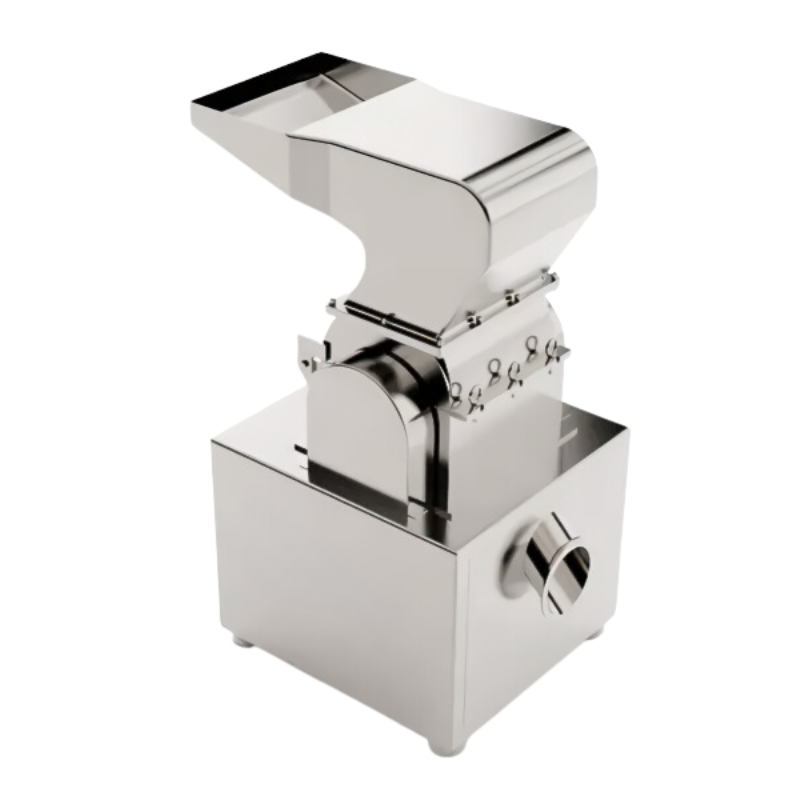
- Robust design for breaking large materials
- Pre-grinding solution for coarse particles
- Ideal for primary crushing in pharmaceutical processing

- Efficient grinding with minimal heat generation
- Suitable for medium-fine powders
- Compact design for versatile applications

- Achieves ultra-fine grinding with high-speed airflow
- Ideal for heat-sensitive materials
- Consistent particle size for precision applications

- Powerful grinding for tough materials like herbs
- High throughput for large-scale processing
- Simple operation and easy maintenance

- Specialized for temperature-sensitive materials
- Utilizes liquid nitrogen for ultra-cold grinding
- Prevents thermal degradation during processing

- Multi-purpose grinder for diverse materials
- Adjustable settings for various particle sizes
- Durable design for continuous operation
Powder Grinder Machine Technical Parameters
| Parameter | Pharmaceuticals Coarse Crusher | Single Pin Mill | Jet Super Fine Mill | Hammer Herb Grinder | Cryogenic Powder Grinder Machine | Universal Pulverizing Machine |
|---|---|---|---|---|---|---|
| Capacity | Up to 500 kg/h | 50–1000 kg/h | 2–100 kg/h | 100–2000 kg/h | 50–500 kg/h | 20–300 kg/h |
| Particle Size Range | 0.5–20 mm | 50–500 µm | 1–10 µm | 100–1000 µm | 10–100 µm | 20–200 µm |
| Power Consumption | 5–15 kW | 3–30 kW | 10–50 kW | 5–50 kW | 10–30 kW | 2–15 kW |
| Material Compatibility | Hard and brittle materials | Various dry materials | Heat-sensitive materials | Fibrous and tough materials | Temperature-sensitive materials | Wide range of materials |
| Special Features | Robust design for primary crushing; adjustable output size | High-speed rotor; fine to medium grinding; easy maintenance | Uses high-speed air jets; ultra-fine grinding; no heat generation | High-speed hammers; suitable for herbs and spices | Utilizes liquid nitrogen; prevents thermal degradation | Versatile applications; interchangeable screens; consistent particle size |
Powder Grinder Machine Working Principle
Pharmaceuticals Coarse Crusher
- Preparation:
- Inspect and clean the crushing chamber. Ensure all blades or hammers are securely attached.
- Adjust the output size setting based on the desired particle size.
- Operation:
- Feed large materials into the inlet manually or via a conveyor.
- The rotating blades or hammers break down the material into coarse particles.
- Discharge the crushed material through the adjustable outlet.
- Post-Operation:
- Remove any remaining debris, clean the chamber, and inspect the components for wear.
Single Pin Mill
- Preparation:
- Clean the mill and ensure the rotor is securely in place.
- Set the desired speed and adjust the screen for the required particle size.
- Operation:
- Feed the material into the hopper.
- The high-speed rotor grinds the material against the fixed pin or screen, producing fine particles.
- Collect the ground material at the discharge port.
- Post-Operation:
- Disassemble and clean the rotor and screens to prevent cross-contamination.
Jet Super Fine Mill
- Preparation:
- Check the compressed air supply and ensure the air nozzles are clear.
- Set the desired particle size using the classifier.
- Operation:
- Introduce the material into the mill's chamber.
- High-velocity air streams create a jet of particles, causing collisions that reduce the size to ultra-fine powders.
- The classifier separates particles by size, directing them to the appropriate outlet.
- Post-Operation:
- Clean the air nozzles, chamber, and classifier thoroughly to maintain precision.
Hammer Herb Grinder
- Preparation:
- Inspect and clean the hammer chamber and screens.
- Set the required screen size for desired particle output.
- Operation:
- Feed the material into the grinder's hopper.
- Rotating hammers impact the material, breaking it down into smaller pieces.
- The material passes through the screen, achieving the desired size before discharge.
- Post-Operation:
- Remove the hammers for cleaning and inspect for wear. Replace screens as necessary.
Cryogenic Powder Grinder Machine
- Preparation:
- Ensure the liquid nitrogen tank is filled and connected properly.
- Cool the grinding chamber to the required temperature.
- Operation:
- Feed the material into the chamber.
- Liquid nitrogen freezes the material, making it brittle for easier grinding.
- The frozen material is ground into fine particles and collected at the discharge port.
- Post-Operation:
- Clean the chamber and components, ensuring no residual nitrogen or debris remains.
Universal Pulverizing Machine
- Preparation:
- Select and install the appropriate screen size for the desired particle size.
- Inspect and clean the grinding chamber.
- Operation:
- Introduce the material into the hopper.
- The rotating blades grind the material against the fixed wall or screen.
- Collect the output at the discharge point.
- Post-Operation:
- Clean the grinding chamber and screen. Check and replace worn parts as needed.
Frequently Asked Questions
A powder grinder machine is essential for reducing raw materials into fine powders, ensuring uniform particle size for consistent pharmaceutical formulations. It improves processing efficiency and product quality.
A pharmaceutical pulverizer can process a wide range of materials, including herbs, active pharmaceutical ingredients (APIs), and brittle compounds. It is designed to handle materials with varying hardness and moisture levels.
Most powder grinder machines are equipped with safety features such as overload protection, automatic shutoff, and sealed grinding chambers to prevent contamination and ensure operator safety during use.
Key factors include processing capacity, particle size range, material compatibility, and ease of maintenance. For pharmaceutical applications, compliance with hygiene and GMP standards is also critical.
Yes, specific types, such as cryogenic grinders or jet super fine mills, are designed for heat-sensitive materials. They prevent thermal degradation by using cooling systems or high-velocity airflow.
Regular cleaning of the grinding chamber, inspection of moving parts, and replacement of worn components are necessary to maintain performance and accuracy over time.