


Understanding Lawn Sweepers

A lawn sweeper is an excellent tool for keeping the yard tidy while efficiently collecting debris such as leaves, grass clippings, and small twigs. It uses rotating brushes to lift and sweep debris into a hopper or collection bag while it is pushed or towed on the lawn. In a way, lawn sweepers really save time and effort compared to raking, and they provide a more thorough cleaning. They are especially beneficial across large yards and go a long way towards limiting the strain of manual labor, hence making yard maintenance all the easier and effective.
What is a Lawn Sweeper?
Lawn sweepers are landscaping tools designed to efficiently collect leaves, grass clippings, and other debris from lawns, utilizing rotating brushes that push the waste into a hopper or bag.
Benefits of Using a Lawn Sweeper
Time-Saving
Lawn sweepers work faster over large areas compared to manual raking, which has a significant impact on the time available for other yard cleanup tasks. For example, some homeowners with a half-acre yard have testified that they complete their lawn cleaning tasks in less than half the usual time.
Effort Reduction
In manual raking, one must exert considerable physical effort. But operating lawn sweepers would include little effort. This makes it an incredibly convenient choice for people of all ages who intend to reduce physical strain and backache.
Better cleaning capacity
The revolving brushes of the lawn sweeper are designed to capture debris more effectively than human methods. They can pick up even the tiniest things, such as pine needles or acorns, ensuring the lawn is perfectly clean.
Eco-Friendly
Being independent of gasoline or electricity, lawn sweepers make an environmentally friendly choice. This way, a lawn sweeper contributes to emission reduction as compared with a gas-powered leaf blower and in turn promotes sustainable lawn-care practices.
Versatility
Secondary terrains and surfaces compatible with newer lawn sweepers include grass, pavement, driveway, and gravel. Second, several models offer convenient adjustments according to debris variation and yard conditions.
Types of Lawn Sweepers
Lawn sweepers vary in type, each designed to cater to specific purposes and yard conditions. Below are the primary types of lawn sweepers, along with their details and features for your consideration.
Push Lawn Sweepers
Push-type lawn sweepers are operated manually and are just suited for smaller yards. They are lightweight, working in sync with the user’s movement, and are an excellent choice for anyone seeking to remain environmentally friendly while being cost-efficient. Typically, these sweepers have a debris hopper size ranging from 7 to 15 cubic feet, and they perform their job well, collecting scattered leaves, grass clippings, and lighter debris.
Best for:
Light debris and small yard.
Advantages:
- Inexpensive
- No fuel or electricity costs
- Will fit anywhere
Limitations:
- Have to push
- Doesn’t work well on uneven grounds
Tow-Behind Lawn Sweepers
Tow-behind attachments attach to lawn tractors or ride-on mowers, making them ideal for medium to large-sized yards. The hopper capacity is typically larger (15 to 26 cubic feet) and can pick up a diverse array of debris, including Douglas fir, heavier twigs, and pine cones.
Best for:
Medium to large yards or properties that require frequent clearing of debris.
Advantages:
- Big capacity
- Less laborious for clearing bigger areas
Limitation:
- Requires towing vehicle
Powered Lawn Sweepers
Powered lawn sweepers are typically either electric or gas-powered; they have their brushes driven by the motor, requiring the least user effort to perform debris collection. These sweepers are slightly better suited for larger properties with dense pile-ups.
Best for:
Large residential or commercial setup.
Advantages:
- Fast and efficient at removing heavy and stubborn debris
- Also versatile on different terrains
Limitations:
- Expensive
- Requires fuel or electricity
- May be noisier than manual ones
Lawn Sweepers That Are Vacuums
While they aren’t traditional lawn sweepers, handheld vacuums with sweeping features are definitely on the rise. Great all-purpose tools, they allow you to pick up light debris in hard-to-reach places.
Best for:
Tight spaces, corners, and hard surfaces like patios or driveways.
Advantages:
- Portability and ease in handling
Limitations:
- Limited capacity and still only good for small areas
Comparison of Popular Models
| Type | Example Model | Hopper Capacity | Price Range | Key Feature |
|---|---|---|---|---|
| Push Lawn Sweeper | Scotts LSW70026S | 26 gallons | $90 – $150 | Lightweight and adjustable. |
| Tow-Behind Sweeper | Agri-Fab 45-0492 | 25 cubic feet | $300 – $450 | High capacity with adjustable height. |
| Powered Sweeper | Earthwise LSW70021 | 21 inches wide | $200 – $300 | Electric-powered with efficient brushes. |
| Handheld Vacuum/Sweeper | Black+Decker BEBL7000 | 12 gallons | $100 – $200 | Multi-functional suction and sweeping. |
Understanding these options and their specific features can help you select the best lawn sweeper to meet your needs, ensuring an efficient and environmentally friendly way to maintain your yard.
Choosing the Best Lawn Sweeper
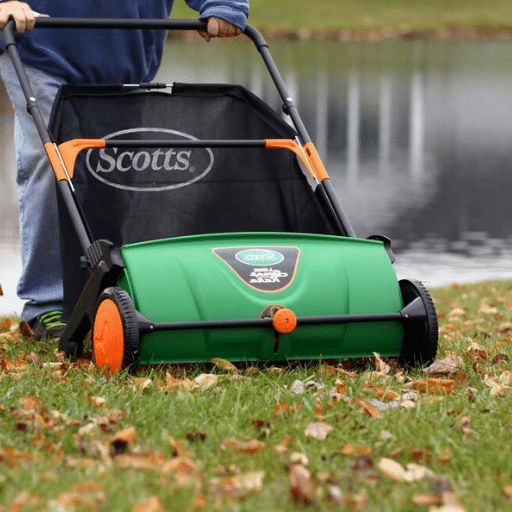
The type of lawn and the size of the yard should be considered when selecting a lawn sweeper. For smaller to medium-sized gardens, manual push-type lawn sweepers are usually satisfactory and cost-effective. Larger lawns with heavy debris will benefit more from the tow-behind type, mainly when used with tractors. Those who want less physical exertion and more efficiency should consider electric sweepers. Concentrate on features such as sweep width, hopper capacity, and easy storage that cater to your specific needs. Make your choice based on what suits your needs and the level of maintenance you intend to perform in the garden.
Factors to Consider
Many factors contribute to choosing the right lawn sweeper, making the selection process more challenging. Below are five essential considerations, along with some information and data for each:
Sweeping width
The sweeping width determines the amount of space a sweeper can cover in a single pass. Sweepers with a wider bounce, in the range of 42-50 inches, are suitable for lawn companies as they reduce the number of passes required. For smaller backyard areas, the small models with 21-30 inch width suffice.
Hopper capacity
Hopper capacity indicates the amount of debris a sweeper can hold before needing to be emptied. Larger ones, measuring 18-50 cubic feet, are further suitable if you have lawnland or heavy debris loads, while small hoppers should suffice for small yards.
Type of debris
What is the type of debris that you need to pick up: leaves, grass clippings, branches, or pine cones? Stand by: Some sweepers are particularly well-suited for finer materials, while others are stronger for handling heavier debris.
Maneuverability
Weight, wheel size, and construction are some key elements that contribute to this characteristic. Lightweight sweepers with large, durable wheels provide greater control and ease of use, as they glide smoothly over uneven terrain or navigate through tight spaces.
Storage space
Storage space for the sweeper should be considered. However, foldable sweepers or those with detachable parts are more convenient if you have limited storage space. In such cases, a compact design is more favorable for homeowners with a small garage or shed.
Top Features to Look For
Adjustable Height Settings
Usually, sweepers have adjustable heights so that users can set the machine accordingly. If heights are adjustable, then moving the sweeper from hard floors to carpets will be quite easy, thus giving the best cleaning results. A sweeper with more height positions is preferable; sometimes, these range from 1 inch all the way up to over 3 inches.
Sweeper Width
Having a larger width of cleaning path increases the cleaning efficiency with the sweepers. A manual sweeper in a standard range is typically 21 to 26 inches wide, whereas a powered sweeper can have a cleaning width of up to 35 inches or more. Cleaning sweepers with a wider width work faster for cleaning large areas, while narrow sweepers are better suited for small areas or along edges.
Brush System
Brushes are responsible for sweeping in any direction, collecting or lifting impingements. Dual or triple-stage brushes typically cover broader areas and can collect fine dust, leaves, and even large debris such as small pebbles. Cylindrical brush systems, combined with side brushes, can enhance edge cleaning by up to 30% according to advanced designs.
Debris Capacity
A sweeper hopper should be capable of holding large amounts of dirt while being easy to empty. For instance, some standard manual sweepers have hoppers with a 5-gallon capacity, whereas high-capacity models can hold up to about 14 gallons. It would be better if the large hopper requires less frequent emptying.
Durability and Build Quality
Additionally, aluminum or reinforced polycarbonate ensures greater durability without adding excessive weight. Besides, the wheel must be well-constructed to provide good support on uneven ground and maintain its stability over time.
Energy efficiency concerning powered models
If you choose a powered sweeper, you can save money with an energy-efficient design that is designed to conserve battery life. Recent models boast lithium-ion batteries that provide significantly longer runtimes; some are able to stay operational for up to 3 hours before requiring a full charge.
Ease of Maintenance
They also look for a sweeper that has tool-less maintenance for non-experts. For example, brushes and hoppers can be detached easily to simplify cleaning and part replacement. On this note, some models even feature intuitive indicator lights that alert you when a specific component needs servicing.
You can pick a sweeper best suited to your suggested needs by considering these technologies and data. That way, you get a sweeper that really works and lasts.
Comparison of Popular Models
| Model | Type | Sweeping Path | Hopper Capacity | Weight | Price | Key Features |
|---|---|---|---|---|---|---|
| Agri-Fab 44-Inch Lawn Sweeper | Tow-Behind | 44 inches | 25 cubic feet | 95 lbs | $455 | Lightweight, easy to empty, durable |
| Earthwise 21-Inch Push Sweeper | Push | 21 inches | 3.2 cubic feet | 14 lbs | $136 | Compact, budget-friendly, easy storage |
| Ohio Steel 50-Inch Sweeper | Tow-Behind | 50 inches | 26 cubic feet | 102 lbs | $400 | Wide path, efficient, gentle on grass |
| Scotts 26-Inch Push Sweeper | Push | 26 inches | 4.48 cubic feet | 19.34 lbs | $180 | Lightweight, comfortable grip, compact |
| Craftsman 42-Inch Sweeper | Tow-Behind | 42 inches | 22 cubic feet | Not listed | $450 | Durable, handles large debris, versatile |
Push Lawn Sweepers vs. Tow-Behind Lawn Sweepers

| Feature | Push Lawn Sweepers | Tow-Behind Lawn Sweepers |
|---|---|---|
| Operation | Manually pushed | Towed by tractor or mower |
| Best for | Small yards | Large yards |
| Sweeping Path | 21-26 inches | 42-50 inches |
| Hopper Capacity | 3-6 cubic feet | 22-26 cubic feet |
| Ease of Use | Lightweight, easy to maneuver | Requires towing equipment |
| Storage | Compact, easy to store | Requires larger storage space |
| Price Range | $100-$200 | $300-$500 |
| Debris Collection | Light debris like leaves, grass | Handles heavier debris |
| Assembly | Simple setup | More complex assembly |
| Durability | Suitable for light use | Built for heavy-duty tasks |
Advantages of Push Lawn Sweepers
Compact and Easy to Maneuver
Perfect for gardens and yards with obstacles and smaller areas, push lawn sweepers are well-suited for such purposes. Their negligible weight makes it easy to steer, even in tight spaces.
Budget-Friendly Approach
Generally, they are cheaper than tow-behind types. They provide an effective debris collection system with minimal investment.
No Threat of Additional Equipment
Being manually operated, they don’t require a tow from a tractor or a mower. This becomes even more advantageous for those who don’t actually have a towing vehicle, or would rather go standalone.
Ease of Maintenance
Lawn sweepers contain fewer complicated elements and have no engine or power source; therefore, they require very little maintenance, which ensures their long life and makes them inexpensive to maintain.
Petroleum-Free Lawn Care
This manual power is also a significant factor in push lawn sweepers’ being pollution-free, noise-free, and an environmentally friendly choice while maintaining the tranquility of your outdoor experience.
Benefits of Tow-Behind Lawn Sweepers
Time Efficiency
Tow-behind lawn sweepers cover large areas due to their broad sweeping paths, significantly reducing the time required for yard cleanup compared to manual methods.
High-Capacity Collection
These sweepers feature large hoppers that can retain a large quantity of debris, including leaves, grass clippings, and twigs. This would reduce the frequency of emptying and increase productivity.
Ease of Use
Attachable to a tractor or riding mower for towing, tow-behind lawn sweepers require minimal operator input to do most of the work. These machines are perfect for those with limitations or with huge properties to maintain.
Versatility
Tow-behind sweepers are effective for different hazards, while they can operate on various terrains, from flat lawns to areas that are slightly uneven or sloped. This adaptability ensures thorough maintenance of the property.
Durability and Longevity
Constructed from rugged materials and high-quality components, these sweepers are designed to withstand severe usage and rough environmental conditions, providing reliable performance for years.
Which is Right for Your Lawn?
Depending on the size of your lawn, terrain type, and specific maintenance requirements, sweeper selection will vary, with tow-behind sweepers being most suited for large areas and severe debris.
Using a Lawn Sweeper Effectively

To get the topmost results from a lawn sweeper, enormous obstacles like a branch or rock are cleared first from the lawn. Subsequently, the brush height needs to be set to fiber length so that debris can be efficiently collected. Drive at a consistent moderate speed so that the sweeper can efficiently collect the leaves, grass clippings, and debris. Continue hiring, as some debris in the hopper can affect performance. Dry lawn works best; moist debris can clog brushes or prevent efficient collection.
Best Practices for Lawn Sweeping
1. Prepare Your Lawn Thoroughly
Remove any larger debris prior to work, such as branches and stones. These obstacles can damage performance or tip the balance of the machine. The smoother the surface, the better the sweeping. In preparation for sweeping, a clean lawn can save up to 20% of time, according to research.
2. Set Brush Height Properly
Setting the brush height correctly is a crucial part of achieving efficiency. When the brushes are set too low, they dig into the soil and cause damage, yet they cannot collect much debris. The brushes should skim the surface of the soil so that they can pick up debris. It is recommended to adjust the height while clearing different grass lengths or uneven surfaces.
3. Choose the Right Timing
Sweeping is best done on dry lawns. Wet grass clippings and leaves can stick to the brushes and clog the sweeper, thus impeding its performance. It is recommended to check the weather forecast and plan for sweeping on days that are warm and dry to achieve a 30% efficiency enhancement.
4. Maintain a Steady Speed
The lawn sweeper should be operated at a consistent moderate speed to allow the brushes to pick up debris effectively. Studies have shown that too fast a pace can cause it to leave 40-50% of debris behind, requiring it to be done again.
5. Empty the Hopper Often
The hopper, when full or excessively heavy, can diminish the efficiency of the lawn sweeper. Hence, empty your collected debris at regular intervals to ensure constant performance. Here’s a professional tip: plan to stop early during longer sweeping sessions to empty the hopper, ensuring the machine works smoothly until the end.
6. Choose Suitable Sweeping Patterns
Use overlapping patterns during sweeping, comparable to mower stripes to ensure the entire lawn is covered. Studies recommend about 10-20% overlap between passes to avoid any misses or uneven collection.
7. Routine Cleaning and Inspection of the Lawn Sweeper
This will help to reduce the inconvenience caused by debris accumulation and increase the lifespan by cleaning the brushes, wheels, and hoppers after every use. Checking the moving parts every month can identify wear and tear in its early stages, thus saving repair costs by up to 15%.
Keeping those best practices in mind pictorially will ensure that your lawn sweeper works efficiently to give you a pristine and well-tended yard with minimal hassle.
How to Maintain Your Lawn Sweeper
The proper maintenance of your lawn sweeper promises a longer life and better performance. The five steps listed below may help ensure your equipment remains in top condition:
1. Clean After Every Use
Once you’ve carried it out, always remove the debris that may remain lodged in the brushes, wheels, or hopper. Aimlessness to maintain them could clog it up and lower its performance.
2. Inspect Brushes Regularly
Check the wear on the brushes, especially if the sweeper is used regularly. Worn brushes may reduce the effectiveness of sweeping. It is best to replace them when the bristle length has been reduced by 30%.
3. Lubricate Moving Parts
Grease all moving parts, such as wheel axles and bearings, every two months to ensure optimal performance. This will reduce friction and increase the component life by almost 25%.
4. Check Tires and Wheels
Examine the tires for damage or loss of air if your sweeper is wheel-driven. Properly inflated and aligned wheels help with traction and make sweeping easier.
5. Store in a Dry Location
Whenever the sweeper is not in use, store it inside or under a cover. This protection ensures it is kept away from rain and moisture, reducing the incidence of rust formation and increasing its durability.
Tips for Sweeping Leaves and Grass Clippings
Choose the Appropriate Time
Sweep only when the ground and leaves are dry; wet leaves and grass clippings tend to stick together, making them more challenging to gather. Dry conditions can increase sweeping efficiency by approximately 30%.
Use the Proper Sweeper Setting
Use height and power settings suitable for sweepers based on the terrain and the type of debris. For instance, a lower setting would work well on even and smooth surfaces, whereas an uneven ground surface needs a higher setting for adequate ground clearance and proper functioning.
Sweep in a Single Direction
To prevent missing anything and/or being able to pick up debris effectively, sweep in neat rows going in only one direction. This technique allows for as much as a 20% savings in group wasting time in two different directions.
Remove Large Debris First
Clear away larger obstacles, such as well-sized branches and rocks, before sweeping. Larger obstacles can cause damage to the sweeper or reduce its efficiency, leading to increased maintenance costs.
Empty Collector Bags Regularly
Never allow the collector bag or bin to get overfilled, as this will affect performance. Empty the bag frequently to ensure smooth operation and prevent clogging, especially during periods of heavy use.
Additional Lawn Care Tools

- Lawn Mower – This maintains an even and healthy grass height. Both manual and powered versions are available, depending on the size and effort required.
- Trimmer or Edger – The perfect finishing touch along driveways, sidewalks, and flower beds.
- Leaf Blower – The perfect finish for quickly clearing fallen leaves and debris in autumn.
- Rake – A versatile tool that can be used for collecting leaves, grass clippings, or light debris.
- Garden Hose – Watering is applied equally for lawns and plants. Adding sprinklers can make it easy to cover a larger area.
Integrating a Lawn Mower with Your Sweeper
Lawn mowing, combined with lawn sweeping, can significantly enhance the efficiency of a yard maintenance day. By integrating these tools, during mowing, grass clippings, leaves, and debris can be collected and stored; this ultimately saves time and effort. Modern-day sweepers complement lawn mowers perfectly, making them a dual-purpose machine.
When selecting a lawn sweeper to be installed with your mower, make compatibility the number one consideration. Different manufacturers have provided a series of attachment kits that are compatible with specific mower models only, ensuring a proper fit and function. For example, the tow-behind type of lawn sweeper usually fits most riding mowers that have hitch attachment sizes of 1/2 or 5/8 inches. The recommended residential sweeper widths are mostly around 26 to 42 inches, striking a compromise between maneuverability and capacity.
Recent reviews and tests suggest that if these tools are properly paired, one can potentially increase efficiency in outdoor maintenance work by up to 50%. Studies, for example, indicate that tow-behind sweepers can collect up to 80% of lawn debris in just one pass in optimum conditions. Adjustable heights enable maximum versatility, allowing sweepers to adapt to various lawn types.
Combining a lawn mower with a sweeper lessens the intensity of manual labor. Merging cutting with cleaning reduces raking or bagging, thus conserving energy and contributing to a cleaner and healthier yard as debris removal helps inhibit grass growth.
Also crucial for maximum performance is the regular maintenance of your lawn mower and sweeper. Cleaning brushes, sharpening mower blades, and inspecting for wear on your attachments can all help keep it running smoothly and efficiently. This upgrade can be a great help in maintaining your lawn, whether for a small backyard or a larger property.
Using a Leaf Blower for Enhanced Cleanup
Using the blower is a great way to enhance the cleanup of my yard. It allows me to blow leaves, debris, and grass clippings away quickly from areas such as corners, pathways, or flower beds. Changing between powersetting, I get to use less power when working on delicate surfaces, or full power for bigger debris, which makes the depot almost empty within a few minutes, practically a straightforward cleanup.
Understanding Dethatchers and Their Role
Lawn dethatchers are tools that maintain a healthy and beautiful lawn by removing an excess build-up of thatch —a layer of organic material comprising dead grass, roots, and debris—that lies between the soil and growing grass. Any more, thatch becomes an obstruction to the standard passage of water, nutrients, and air to the roots, eventually rendering the lawn unhealthy. With a dethatcher in hand, one can improve soil aeration, promote healthy grass growth, and reduce the likelihood of lawn diseases.
The following are types of dethatchers and their distinguishing features:
Manual Dethatchers
Manual dethatchers or dethatching rakes are simple hand tools usually used for smaller lawns. They are cheap but require hard manual work and are suitable only for minor thatch problems.
Tow-Behind Dethatchers
Tow-behind dethatchers are attachment-based dethatchers designed to be pulled behind a lawn tractor or riding mower. These tools are most suited for medium to large lawns and work efficiently to remove thatch from vast areas.
Electric Dethatchers
Electric dethatchers are powered, lightweight, and efficient, making them suitable for small-to-medium-sized lawns, which is why they are most favored among homeowners.
Gas-Powered Dethatchers
Gas-powered dethatchers are designed for heavy-duty treatment, making them suitable for larger lawns and commercial use. They are more effective against thicker layers of thatch, but are generally noisier and less environmentally friendly.
Combination Aerator-Dethatcher
A multifunctional tool that serves as both a dethatcher and a lawn aerator, making it very practical for homeowners who want to save time by performing two tasks simultaneously.
Understanding the appropriate dethatcher that suits your lawn’s size and condition is essential for achieving optimal results and healthier, vibrant grass.
References
- Staying Competitive in Changing Times
This document discusses the use of lawn sweepers and other tools in grounds maintenance.
Read the document here - Stormwater Management: Yard Waste Management
This guide provides practical advice on lawn maintenance, including the use of sweepers for managing clippings.
Check it out here - Design and Fabrication of a Mechanical Sweeper
This research paper explores the design and operational aspects of mechanical sweepers, which can include lawn sweepers.
Read the research here
Frequently Asked Questions (FAQ)
It operates essentially like a big vacuum cleaner. The sweeper has a spinner brush that sweeps the debris into a bag for disposal. A lawn sweeper can be towed behind a mower-tractor or be a walk-behind model, making them versatile depending on the yard-care needs.
Trend-behind lawn sweepers lend themselves to working on larger yards, as they hook up to a lawn tractor or riding mower. Additionally, they usually feature bigger hopper sizes, meaning longer intervals between visits to empty the debris that has been collected. The many adjustable features will surely allow the brush height, sweeping width to vary, making them effective at picking up equally fallen leaves, pine needles, or grass clippings.
Most lawn sweepers permit the adjustment of the brush height, allowing one to vary it according to the types of debris encountered. The height can be adjusted by locating the height lever or knob on the lawn sweeper and changing it up or down depending on the thickness of the debris. Higher settings are used to collect lighter debris, whereas lower settings collect heavier debris.
The best lawn sweeper for leaves depends mainly on the size of your yard and the quantity of debris. Model alternatives like the Agri-Fab 44-inch lawn sweeper or the Ohio Steel lawn sweeper rank as top models mainly due to their large capacity and excellent ability to gather leaves and fallen debris in a yard.
Lawn sweepers are primarily designed to work on natural turf, but some models could be compatible with artificial turf. You want to make sure that you select a lightweight walk-behind lawn sweeper or one with rubber wheels that will not compromise the turf. Check with the manufacturers first to ensure that their sweepers are safe for use on artificial grass.
Keep your lawn sweeper in top condition for smooth operation through regular maintenance routines. After each use, empty the hopper bag to prevent obstruction and debris buildup. Clean your brushes and look for wear or damage. Apply a bit of lubrication to almost anything that moves, and inspect the rubber wheels for signs of wear; this will help extend the usefulness of your equipment.
Varies from model to model, but a hopper lawn sweeper might offer a capacity of 5.25 gallons, capable of capturing any debris. Tow-behind types of lawn sweepers have larger hoppers than average, with a higher capacity that prevents frequent emptying.
Leaf blowers and lawn sweepers would differ in their functions in yardwork. A leaf blower works to push or move debris to piles, while a lawn sweeper sweeps its debris into the hopper bag. Many homeowners use both methods equally, lest they opt for the maximum efficiency of blowing the leaves into piles and then sweeping them away.


